3.2 Datastore Access
We have explored the architecture in the application's JVM and discussed the application cache and implementation cache. Now let's examine the architectures of JDO implementations. We'll discuss each type of datastore separately.
These architectures don't affect your application's programming model, but they affect the configuration of the environment in which your application executes. In particular, the ConnectionURL property of the Properties instance used to construct the PersistenceManagerFactory refers to a local or remote datastore.
3.2.1 Direct Access of Filesystem or Local Datastore
Some JDO implementations store the objects directly in a local filesystem or datastore. Figure 3-1 illustrates this architecture. There is only a single process context in this architecture. The JDO implementation uses the Java I/O classes directly to manage the storage of the objects in a file. The JDO Reference Implementation implements this architecture, as do some object databases.
3.2.2 Remote Access of a JDO Server
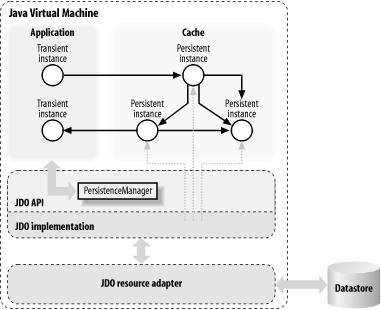
Some JDO implementations connect to a separate server that manages the datastore, as illustrated in Figure 3-7. The JDO Reference Implementation implements this architecture, as do most object databases. In this particular example, the JDO implementation itself provides a server built specifically for object storage, which then manages the filesystem directly. The component that executes in the same JVM as the JDO implementation and communicates with the remote server is called a resource adapter. The protocols between the client JVM and the JDO Server are vendor-specific.
Figure 3-7. Client access of a JDO server
3.2.3 Remote Access of a SQL Datastore
Figure 3-8 illustrates the use of a relational database server for object storage. This is the most common architecture used by current commercial JDO implementations. Since the application is written in Java, the JDO implementation uses JDBC to communicate with the database server. When you deploy your application, you use a proprietary tool supplied by the JDO vendor to map your application's Java objects to tables in the relational database. Some JDO implementations use your application's persistent object model to create the relational schema for you.
Figure 3-8. Client access of a SQL datastore
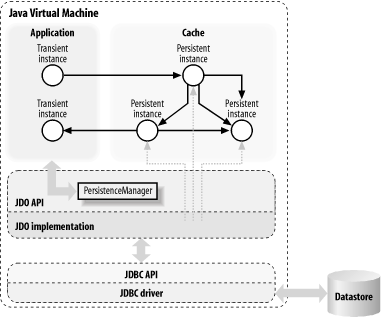
The relational vendor or a third party provides a JDBC driver to communicate with the database, using protocols specific to the database. The JDBC driver is the resource adapter in this architecture.
Since the JDBC interface is well defined, this architecture offers a high degree of portability. JDO implementations have been written to use a variety of datastores that provide a JDBC driver implementation. While the JDBC interface is standard, the SQL data manipulation language, used by the relational databases, varies considerably; the JDO implementation hides these differences from JDO applications.


