1.2 The .NET Framework
Microsoft .NET supports not only language independence, but also language integration. This means that you can inherit from classes, catch exceptions, and take advantage of polymorphism across different languages. The .NET Framework makes this possible with a specification called the Common Type System (CTS) that all .NET components must obey. For example, everything in .NET is an object of a specific class that derives from the root class called System.Object. The CTS supports the general concept of classes, interfaces, delegates (which support callbacks), reference types, and value types.
Additionally, .NET includes a Common Language Specification (CLS), which provides a series of basic rules that are required for language integration. The CLS determines the minimum requirements for being a .NET language. Compilers that conform to the CLS create objects that can interoperate with one another. The entire Framework Class Library (FCL) can be used by any language that conforms to the CLS.
The .NET Framework sits on top of the operating system, which can be any flavor of Windows,[2] and consists of a number of components, currently including:
[2] Because of the architecture of the CLR, the operating system can be potentially any variety of Unix or another operating system altogether.
Four official languages: C#, VB.NET, Managed C++, and JScript.NET
The CLR, an object-oriented platform for Windows and web development that all these languages share
A number of related class libraries, collectively known as the FCL
Figure 1-1 breaks down the .NET Framework into its system architectural components.
Figure 1-1. .NET Framework architecture
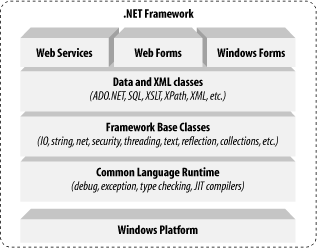
The most important component of the .NET Framework is the CLR, which provides the environment in which programs are executed. The CLR includes a virtual machine, analogous in many ways to the Java virtual machine. At a high level, the CLR activates objects, performs security checks on them, lays them out in memory, executes them, and garbage-collects them. (The Common Type System is also part of the CLR.)
In Figure 1-1, the layer on top of the CLR is a set of framework base classes, followed by an additional layer of data and XML classes, plus another layer of classes intended for web services, Web Forms, and Windows Forms. Collectively, these classes make up the FCL, one of the largest class libraries in history and one that provides an object-oriented API for all the functionality that the .NET platform encapsulates. With more than 4,000 classes, the FCL facilitates rapid development of desktop, client/server, and other web services and applications.
The set of Framework base classes, the lowest level of the FCL, is similar to the set of classes in Java. These classes support rudimentary input and output, string manipulation, security management, network communication, thread management, text manipulation, reflection and collections functionality, etc.
Above this level is a tier of classes that extend the base classes to support data management and XML manipulation. The data classes support persistent management of data that is maintained on backend databases. These classes include the Structured Query Language (SQL) classes to let you manipulate persistent data stores through a standard SQL interface. Additionally, a set of classes called ADO.NET allows you to manipulate persistent data. The .NET Framework also supports a number of classes to let you manipulate XML data and perform XML searching and translations.
Extending the Framework base classes and the data and XML classes is a tier of classes geared toward building applications using three different technologies: Web Services, Web Forms, and Windows Forms. Web services include a number of classes that support the development of lightweight distributed components, which will work even in the face of firewalls and NAT software. Because web services employ standard HTTP and SOAP as underlying communications protocols, these components support Plug and Play across cyberspace.
Web Forms and Windows Forms allow you to apply Rapid Application Development techniques to building web and Windows applications. Simply drag and drop controls onto your form, double-click a control, and write the code to respond to the associated event.
For a more detailed description of the .NET Framework, see .NET Framework Essentials, by Thuan Thai and Hoang Lam (O'Reilly).


