1.4 .NET Framework
Now that you are familiar with the major goals of the .NET Framework, let's briefly examine its architecture. As you can see in Figure 1-2, the .NET Framework sits on top of the operating system, which can be a few different flavors of Windows and consists of a number of components (each of these components is discussed in greater detail starting with Chapter 4, as described in the Preface). .NET is essentially a system application that runs on Windows.
Figure 1-2. The .NET Framework
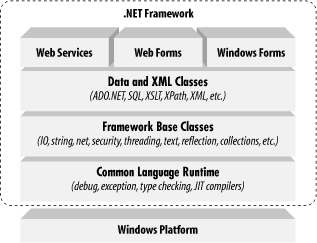
The most important component of the framework is the CLR. If you are a Java programmer, think of the CLR as the .NET equivalent of the Java Virtual Machine (JVM). If you don't know Java, think of the CLR as the heart and soul of the .NET architecture. At a high level, the CLR activates objects, performs security checks on them, lays them out in memory, executes them, and garbage-collects them.
Conceptually, the CLR and the JVM are similar in that they are both runtime infrastructures that abstract the underlying platform differences. However, while the JVM officially supports only the Java language, the CLR supports any language that can be represented in its Common Intermediate Language (CIL). The JVM executes bytecode, so it can, in principle, support many languages, too. Unlike Java's bytecode, though, CIL is never interpreted. Another conceptual difference between the two infrastructures is that Java code runs on any platform with a JVM, whereas .NET code runs only on platforms that support the CLR. In April, 2003, the International Organization for Standardization and the International Electrotechnical Committee (ISO/IEC) recognized a functional subset of the CLR, known as the Common Language Interface (CLI), as an international standard. This development, initiated by Microsoft and developed by ECMA International, a European standards organization, opens the way for third parties to implement their own versions of the CLR on other platforms, such as Linux or Mac OS X. For information on third-party and open source projects working to implement the ISO/IEC CLI and C# specifications, see Appendix A.
In Figure 1-2, the layer on top of the CLR is a set of framework base classes. This set of classes is similar to the set of classes found in STL, MFC, ATL, or Java. These classes support rudimentary input and output functionality, string manipulation, security management, network communications, thread management, text management, reflection functionality, collections functionality, as well as other functions.
On top of the framework base classes is a set of classes that extend the base classes to support data management and XML manipulation. These classes, called ADO.NET, support persistent data managementdata that is stored on backend databases. Alongside the data classes, the .NET Framework supports a number of classes to let you manipulate XML data and perform XML searching and XML translations.
Classes in three different technologies (including web services, Web Forms, and Windows Forms) extend the framework base classes and the data and XML classes. Web services include a number of classes that support the development of lightweight distributed components, which work even in the face of firewalls and NAT software. These components support plug-and-play across the Internet, because web services employ standard HTTP and SOAP.
Web Forms, the key technology behind ASP.NET, include a number of classes that allow you to rapidly develop web Graphical User Interface (GUI) applications. If you're currently developing web applications with Visual Interdev, you can think of Web Forms as a facility that allows you to develop web GUIs using the same drag-and-drop approach as if you were developing the GUIs in Visual Basic. Simply drag-and-drop controls onto your Web Form, double-click on a control, and write the code to respond to the associated event.
Windows Forms support a set of classes that allow you to develop native Windows GUI applications. You can think of these classes collectively as a much better version of the MFC in C++ because they support easier and more powerful GUI development and provide a common, consistent interface that can be used in all languages.
In the next chapter, we examine the internals of the CLR and how it supports and executes .NET components, formally called assemblies in .NET.


