2.7 CLR Execution
Now that you understand the elements of a .NET executable, let's talk about the services that the CLR provides to support management and execution of .NET assemblies. There are many fascinating components in the CLR, but for brevity, we will limit our discussions to just the major components, as shown in Figure 2-4.
Figure 2-4. Major CLR components: the Virtual Execution System (VES)
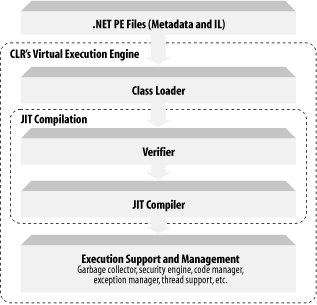
The major components of the CLR include the class loader, verifier, JIT compilers, and other execution support, such as code management, security management, garbage collection, exception management, debug management, marshaling management, thread management, and so on. As you can see from Figure 2-4, your .NET PE files lay on top of the CLR and execute within the CLR's Virtual Execution System (VES), which hosts the major components of the runtime. Your .NET PE files will have to go through the class loader, the type verifier, the JIT compilers, and other execution support components before they will execute.
2.7.1 Class Loader
When you run a standard Windows application, the OS loader loads it before it can execute. At the time of this writing, the default loaders in the existing Windows operating systems, such as Windows 98, Windows Me, Windows 2000, and so forth, recognize only the standard Windows PE files. As a result, Microsoft has provided an updated OS loader for each of these operating systems that support the .NET runtime. The updated OS loaders know the .NET PE file format and can handle the file appropriately.
When you run a .NET application on one of these systems that have an updated OS loader, the OS loader recognizes the .NET application and thus passes control to the CLR. The CLR then finds the entry point, which is typically Main( ), and executes it to jump-start the application. But before Main( ) can execute, the class loader must find the class that exposes Main( ) and load the class. In addition, when Main( ) instantiates an object of a specific class, the class loader also kicks in. In short, the class loader performs its magic the first time a type is referenced.
The class loader loads .NET classes into memory and prepares them for execution. Before it can successfully do this, it must locate the target class. To find the target class, the class loader looks in several different places, including the application configuration file (.config) in the current directory, the GAC, and the metadata that is part of the PE file, specifically the manifest. The information that is provided by one or more of these items is crucial to locating the correct target class. Recall that a class can be scoped to a particular namespace, a namespace can be scoped to a particular assembly, and an assembly can be scoped to a specific version. Given this, two classes, both named Car, are treated as different types even if the version information of their assemblies are the same.
Once the class loader has found and loaded the target class, it caches the type information for the class so that it doesn't have to load the class again for the duration of this process. By caching this information, it will later determine how much memory is needed to allocate for the newly created instance of this class. Once the target class is loaded, the class loader injects a small stub, like a function prolog, into every single method of the loaded class. This stub is used for two purposes: to denote the status of JIT compilation and to transition between managed and unmanaged code. At this point, if the loaded class references other classes, the class loader will also try to load the referenced types. However, if the referenced types have already been loaded, the class loader has to do nothing. Finally, the class loader uses the appropriate metadata to initialize the static variables and instantiate an object of the loaded class for you.
2.7.2 Verifier
Scripting and interpreted languages are very lenient on type usages, allowing you to write code without explicit variable declarations. This flexibility can introduce code that is extremely error-prone and hard to maintain, and that is often a culprit for mysterious program crashes. Unlike scripting and interpreted languages, compiled languages require types to be explicitly defined prior to their use, permitting the compiler to ensure that types are used correctly and the code will execute peacefully at runtime.
The key here is type safety, and it is a fundamental concept for code verification in .NET. Within the VES, the verifier is the component that executes at runtime to verify that the code is type safe. Note that this type verification is done at runtime and that this is a fundamental difference between .NET and other environments. By verifying type safety at runtime, the CLR can prevent the execution of code that is not type safe and ensure that the code is used as intended. In short, type safety means more reliability.
Let's talk about where the verifier fits within the CLR. After the class loader has loaded a class and before a piece of IL code can execute, the verifier kicks in for code that must be verified. The verifier is responsible for verifying that:
The metadata is well formed, meaning the metadata must be valid.
The IL code is type safe, meaning type signatures are used correctly.
Both of these criteria must be met before the code can be executed because JIT compilation will take place only when code and metadata have been successfully verified. In addition to checking for type safety, the verifier also performs rudimentary control-flow analysis of the code to ensure that the code is using types correctly. You should note that since the verifier is a part of the JIT compilers, it kicks in only when a method is being invoked, not when a class or assembly is loaded. You should also note that verification is an optional step because trusted code will never be verified but will be immediately directed to the JIT compiler for compilation.
2.7.3 JIT Compilers
JIT compilers play a major role in the .NET platform because all .NET PE files contain IL and metadata, not native code. The JIT compilers convert IL to native code so that it can execute on the target operating system. For each method that has been successfully verified for type safety, a JIT compiler in the CLR will compile the method and convert it into native code.
One advantage of a JIT compiler is that it can dynamically compile code that is optimized for the target machine. If you take the same .NET PE file from a one-CPU machine to a two-CPU machine, the JIT compiler on the two-CPU machine knows about the second CPU and may be able to spit out the native code that takes advantage of the second CPU. Another obvious advantage is that you can take the same .NET PE file and run it on a totally different platform, whether it be Windows, Unix, or whatever, as long as that platform has a CLR.
For optimization reasons, JIT compilation occurs only the first time a method is invoked. Recall that the class loader adds a stub to each method during class loading. At the first method invocation, the VES reads the information in this stub, which tells it that the code for the method has not been JIT-compiled. At this indication, the JIT compiler compiles the method and injects the address of the native method into this stub. During subsequent invocations to the same method, no JIT compilation is needed because each time the VES goes to read information in the stub, it sees the address of the native method. Because the JIT compiler only performs its magic the first time a method is invoked, the methods you don't need at runtime will never be JIT-compiled.
The compiled, native code lies in memory until the process shuts down and until the garbage collector clears off all references and memory associated with the process. This means that the next time you execute the process or component, the JIT compiler will again perform its magic.
If you want to avoid the cost of JIT compilation at runtime, you can use a special tool called ngen.exe, which compiles your IL during installation and setup time. Using ngen, you can JIT-compile the code once and cache it on the machine so that you can avoid JIT compilation at runtime (this process is referred to as pre-JITting). In the event that the PE file has been updated, you must PreJIT the PE file again. Otherwise, the CLR can detect the update and dynamically command the appropriate JIT compiler to compile the assembly.
2.7.4 Execution Support and Management
By now, you should see that every component in the CLR that we've covered so far uses metadata and IL in some way to successfully carry out the services that it supports. In addition to the provided metadata and generated managed code, the JIT compiler must generate managed data that the code manager needs to locate and unwind stack frames.[12] The code manager uses managed data to control the execution of code, including performing stack walks that are required for exception handling, security checks, and garbage collection. Besides the code manager, the CLR also provides a number of important execution-support and management services. A detailed discussion of these services is beyond the scope of this book, so we will briefly enumerate a few of them here:
[12] By the way, you can write a custom JIT compiler or a custom code manager for the CLR because the CLR supports the plug-and-play of these components.
- Garbage collection
-
Unlike C++, where you must delete all heap-based objects manually, the CLR supports automatic lifetime management for all .NET objects. The garbage collector can detect when your objects are no longer being referenced and perform garbage collection to reclaim the unused memory.
- Exception handling
-
Prior to .NET, there was no consistent method for error or exception handling, causing lots of pain in error handling and reporting. In .NET, the CLR supports a standard exception-handling mechanism that works across all languages, allowing every program to use a common error-handling mechanism. The CLR exception-handling mechanism is integrated with Windows Structured Exception Handling (SEH).
- Security support
-
The CLR performs various security checks at runtime to make sure that the code is safe to execute and that the code is not breaching any security requirements. In addition to supporting code access security, the security engine also supports declarative and imperative security checks. Declarative security requires no special security code, but you have to specify the security requirements through attributes or administrative configuration. Imperative security requires that you write the code in your method to specifically cause security checks.
- Debugging support
-
The CLR provides rich support for debugging and profiling. There is an API that compiler vendors can use to develop a debugger. This API contains support for controlling program execution, breakpoints, exceptions, control flow, and so forth. There is also an API for tools to support the profiling of running programs.
- Interoperation support
-
The CLR supports interoperation between the managed (CLR) and unmanaged (no CLR) worlds. The COM Interop facility serves as a bridge between COM and the CLR, allowing a COM object to use a .NET object, and vice versa. The Platform Invoke (P/Invoke) facility allows you to call Windows API functions.
This is by no means an exhaustive list. The one thing that we want to reiterate is that like the class loader, verifier, JIT compiler, and just about everything else that deals with .NET, these execution-support and management facilities all use metadata, managed code, and managed data in some way to carry out their services.


