Section 1.2. A Data Communications Model
To discuss computer networking, it is necessary to use terms that have special meaning. Even other computer professionals may not be familiar with all the terms in the networking alphabet soup. As is always the case, English and computer-speak are not equivalent (or even necessarily compatible) languages. Although descriptions and examples should make the meaning of the networking jargon more apparent, sometimes terms are ambiguous. A common frame of reference is necessary for understanding data communications terminology.
An architectural model developed by the International Standards Organization (ISO) is frequently used to describe the structure and function of data communications protocols. This architectural model, which is called the Open Systems Interconnect (OSI) Reference Model, provides a common reference for discussing communications. The terms defined by this model are well understood and widely used in the data communications communityso widely used, in fact, that it is difficult to discuss data communications without using OSI's terminology.
The OSI Reference Model contains seven layers that define the functions of data communications protocols. Each layer of the OSI model represents a function performed when data is transferred between cooperating applications across an intervening network. Figure 1-1 identifies each layer by name and provides a short functional description for it. Looking at this figure, the protocols are like a pile of building blocks stacked one upon another. Because of this appearance, the structure is often called a stack or protocol stack.
Figure 1-1. The OSI Reference Model
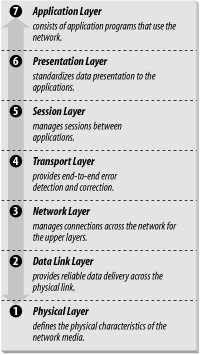
A layer does not define a single protocolit defines a data communications function that may be performed by any number of protocols. Therefore, each layer may contain multiple protocols, each providing a service suitable to the function of that layer. For example, a file transfer protocol and an electronic mail protocol both provide user services, and both are part of the Application Layer.
Every protocol communicates with its peers. A peer is an implementation of the same protocol in the equivalent layer on a remote system; i.e., the local file transfer protocol is the peer of a remote file transfer protocol. Peer-level communications must be standardized for successful communications to take place. In the abstract, each protocol is concerned only with communicating to its peers; it does not care about the layers above or below it.
However, there must also be agreement on how to pass data between the layers on a single computer, because every layer is involved in sending data from a local application to an equivalent remote application. The upper layers rely on the lower layers to transfer the data over the underlying network. Data is passed down the stack from one layer to the next until it is transmitted over the network by the Physical Layer protocols. At the remote end, the data is passed up the stack to the receiving application. The individual layers do not need to know how the layers above and below them function; they need to know only how to pass data to them. Isolating network communications functions in different layers minimizes the impact of technological change on the entire protocol suite. New applications can be added without changing the physical network, and new network hardware can be installed without rewriting the application software.
Although the OSI model is useful, the TCP/IP protocols don't match its structure exactly. Therefore, in our discussions of TCP/IP, we use the layers of the OSI model in the following way:
- Application Layer
-
The Application Layer is the level of the protocol hierarchy where user-accessed network processes reside. In this text, a TCP/IP application is any network process that occurs above the Transport Layer. This includes all of the processes that users directly interact with as well as other processes at this level that users are not necessarily aware of.
- Presentation Layer
-
For cooperating applications to exchange data, they must agree about how data is represented. In OSI, the Presentation Layer provides standard data presentation routines. This function is frequently handled within the applications in TCP/IP, though TCP/IP protocols such as XDR and MIME also perform this function.
- Session Layer
-
As with the Presentation Layer, the Session Layer is not identifiable as a separate layer in the TCP/IP protocol hierarchy. The OSI Session Layer manages the sessions (connections) between cooperating applications. In TCP/IP, this function largely occurs in the Transport Layer, and the term "session" is not used; instead, the terms "socket" and "port" are used to describe the path over which cooperating applications communicate.
- Transport Layer
-
Much of our discussion of TCP/IP is directed to the protocols that occur in the Transport Layer. The Transport Layer in the OSI reference model guarantees that the receiver gets the data exactly as it was sent. In TCP/IP, this function is performed by the Transmission Control Protocol (TCP). However, TCP/IP offers a second Transport Layer service, User Datagram Protocol (UDP), that does not perform the end-to-end reliability checks.
- Network Layer
-
The Network Layer manages connections across the network and isolates the upper layer protocols from the details of the underlying network. The Internet Protocol (IP), which isolates the upper layers from the underlying network and handles the addressing and delivery of data, is usually described as TCP/IP's Network Layer.
- Data Link Layer
-
The reliable delivery of data across the underlying physical network is handled by the Data Link Layer. TCP/IP rarely creates protocols in the Data Link Layer. Most RFCs that relate to the Data Link Layer discuss how IP can make use of existing data link protocols.
- Physical Layer
-
The Physical Layer defines the characteristics of the hardware needed to carry the data transmission signal. Features such as voltage levels and the number and location of interface pins are defined in this layer. Examples of standards at the Physical Layer are interface connectors such as RS232C and V.35, and standards for local area network wiring such as IEEE 802.3. TCP/IP does not define physical standardsit makes use of existing standards.
The terminology of the OSI reference model helps us describe TCP/IP, but to fully understand it, we must use an architectural model that more closely matches the structure of TCP/IP. The next section introduces the protocol model we'll use to describe TCP/IP.


