Section 2.2. The IP Address
An IP address is a 32-bit value that uniquely identifies every device attached to a TCP/IP network. IP addresses are usually written as four decimal numbers separated by dots (periods) in a format called dotted decimal notation.[1] Each decimal number represents an 8-bit byte of the 32-bit address, and each of the four numbers is in the range 0-255 (the decimal values possible in a single byte).
[1] Addresses are occasionally written in other formats, e.g., as hexadecimal numbers. Whatever the notation, the structure and meaning of the address are the same.
IP addresses are often called host addresses. While this is common usage, it is slightly misleading. IP addresses are assigned to network interfaces, not to computer systems. A gateway, such as crab (see Figure 2-1), has a different address for each network to which it is connected. The gateway is known to other devices by the address associated with the network that it shares with those devices. For example, rodent addresses crab as 172.16.12.1 while external hosts address it as 10.104.0.19.
Systems can be addressed in three different ways. Individual systems are directly addressed by a host address, which is called a unicast address . A unicast packet is addressed to one individual host. Groups of systems can be addressed using a multicast address, e.g., 224.0.0.9. Routers along the path from the source to the destination recognize the special address and route copies of the packet to each member of the multicast group.[2] All systems on a network are addressed using the broadcast address, e.g., 172.16.255.255. The broadcast address depends on the broadcast capabilities of the underlying physical network.
[2] This is only partially true. Multicasting is not supported by every router. Sometimes it is necessary to tunnel through routers and networks by encapsulating the multicast packet inside a unicast packet.
The broadcast address is a good example of the fact that not all network addresses or host addresses can be assigned to a network device. Some host addresses are reserved for special uses. On all networks, host numbers 0 and 255 are reserved. An IP address with all host bits set to 1 is a broadcast address.[3] The broadcast address for network 172.16 is 172.16.255.255. A datagram sent to this address is delivered to every individual host on network 172.16. An IP address with all host bits set to 0 identifies the network itself. For example, 10.0.0.0 refers to network 10, and 172.16.0.0 refers to network 172.16. Addresses in this form are used in routing tables to refer to entire networks.
[3] There are configuration options that affect the default broadcast address. Chapter 5 discusses these options.
Network addresses with a first byte value greater than 223 cannot be assigned to a physical network, because those addresses are reserved for special use. There are two other network addresses that are used only for special purposes: network 0.0.0.0 designates the default route and network 127.0.0.0 is the loopback address. The default route is used to simplify the routing information that IP must handle. The loopback address simplifies network applications by allowing the local host to be addressed in the same manner as a remote host. These special network addresses play an important part when configuring a host, but these addresses are not assigned to devices on real networks. Despite these few exceptions, most addresses are assigned to physical devices and are used by IP to deliver data to those devices.
The Internet Protocol moves data between hosts in the form of datagrams. Each datagram is delivered to the address contained in the Destination Address (word 5) of the datagram's header. The Destination Address is a standard 32-bit IP address, which contains sufficient information to uniquely identify a network and a specific host on that network.
2.2.1 Address Structure
An IP address contains a network part and a host part, but the format of these parts is not the same in every IP address. The number of address bits used to identify the network and the number used to identify the host vary according to the prefix length of the address. The prefix length is determined by the address bit mask.
An address bit mask works like this: if a bit is on in the mask, that equivalent bit in the address is interpreted as a network bit; if a bit in the mask is off, the bit belongs to the host part of the address. For example, if address 172.22.12.4 is given the network mask 255.255.255.0, which has 24 bits on and 8 bits off, the first 24 bits are the network number and the last 8 bits are the host address. Combining the address and the mask tells us that this is the address of host 4 on network 172.22.12.
Specifying both the address and the mask in dotted decimal notation is cumbersome when writing out addresses. A shorthand notation is available for writing an address with its associated address mask. Instead of writing network 172.31.26.32 with a mask of 255.255.255.224, we can write 172.31.26.32/27. The format of this notation is address/prefix-length, where prefix-length is the number of bits in the network portion of the address. Without this notation, the address 172.31.26.32 could easily be misinterpreted.
Organizations usually obtain official IP addresses by purchasing a block of addresses from their Internet service provider. The ISP normally assigns a single organization a continuous block of addresses that is appropriate for the needs of the organization. For example, a moderately large business might purchase 192.168.16.0/20 while a small business might buy 192.168.32.0/24. Because the prefix shows the length of the network portion of the address, the number of host addresses that are available to an organization (the host portion of the address) is determined by subtracting the prefix from the total number of bits in an address, which is 32. Thus a prefix of 20 leaves 12 bits that are available to be locally assigned. This is called a "12-bit block" of addresses. A prefix of 24 creates an "8-bit block." Of the two sample address blocks, the first is a 12-bit block that encompasses 4,096 addresses from 192.168.16.0 to 192.168.31.255, and the second is an 8-bit block that includes the 256 addresses from 192.168.32.0 to 192.168.32.255.
Each of these address blocks appears to the outside world to be a single "network" address. Thus external routers have one route to the block 192.168.16.0/20 and one route to the block 192.168.32.0/24, regardless of the size of the address block. Internally, however, the organization may have several separate physical networks within the address block. The flexibility of address masks means that service providers can assign arbitrary length blocks of addresses to their customers, and the customers can subdivide those address blocks using different length masks.
2.2.2 Subnets
The structure of an IP address can be locally modified by using host address bits as additional network address bits. Essentially, the "dividing line" between network address bits and host address bits is moved, creating additional networks but reducing the maximum number of hosts that can belong to each network. These newly designated network bits define an address block within the larger address block, which is called a subnet.
Organizations usually decide to subnet in order to overcome topological or organizational problems. Subnetting allows decentralized management of host addressing. With the standard addressing scheme, a central administrator is responsible for managing host addresses for the entire network. By subnetting, the administrator can delegate address assignment to smaller organizations within the overall organizationwhich may be a political expedient, if not a technical requirement. If you don't want to deal with the data processing department, for example, assign them their own subnet and let them manage it themselves.
Subnetting can also be used to overcome hardware differences and distance limitations. IP routers can link dissimilar physical networks together, but only if each physical network has its own unique network address. Subnetting divides a single address block into many unique subnet addresses, so that each physical network can have its own unique address.
A subnet is defined by changing the bit mask of the IP address. A subnet mask functions in the same way as a normal address mask: an "on" bit is interpreted as a network bit; an "off" bit belongs to the host part of the address. The difference is that a subnet mask is only used locally. On the outside, the address is still interpreted using the address mask known to the outside world.
Assume you have a small real estate business that has been assigned the address block 192.168.32.0/24. The bit mask associated with that address block is 255.255.255.0, and the block contains 256 addresses. Further, assume that your business has 10 offices, each with a half-dozen computers, and that you want to allocate some addresses to each office and keep some for future expansion. You can subdivide the 256 address block with a subnet mask that extends the network portion of the address by a few additional bits.
To subdivide 192.168.32.0/24 into 16 subnets, use the mask 255.255.255.240, i.e., 192.168.32.0/28. The first three bytes contain the original network address block; the fourth byte is divided between the subnet address and the address of the host on that subnet. Applying this mask defines the four high-order bits of the fourth byte as the subnet part of the address, and the remaining four bitsthe last four bits of the fourth byteas the host portion of the address. This creates 16 subnets that each contain 14 host addresses, which is better suited to the network topology of your small real estate business. Table 2-1 shows the subnets and host addresses produced by applying this subnet mask to network address 192.168.32.0/24.
|
Network number |
Host address range |
Broadcast address |
|---|---|---|
|
192.168.32.0 |
192.168.32.1 - 192.168.32.14 |
192.168.32.15 |
|
192.168.32.16 |
192.168.32.17 - 192.168.32.30 |
192.168.32.31 |
|
192.168.32.32 |
192.168.32.33 - 192.168.32.46 |
192.168.32.47 |
|
192.168.32.48 |
192.168.32.49 - 192.168.32.62 |
192.168.32.63 |
|
192.168.32.64 |
192.168.32.65 - 192.168.32.78 |
192.168.32.79 |
|
192.168.32.80 |
192.168.32.81 - 192.168.32.94 |
192.168.32.95 |
|
192.168.32.96 |
192.168.32.97 - 192.168.32.110 |
192.168.32.111 |
|
192.168.32.112 |
192.168.32.113 - 192.168.32.126 |
192.168.32.127 |
|
192.168.32.128 |
192.168.32.129 - 192.168.32.142 |
192.168.32.143 |
|
192.168.32.144 |
192.168.32.145 - 192.168.32.158 |
192.168.32.159 |
|
192.168.32.160 |
192.168.32.161 - 192.168.32.174 |
192.168.32.175 |
|
192.168.32.176 |
192.168.32.177 - 192.168.32.190 |
192.168.32.191 |
|
192.168.32.192 |
192.168.32.193 - 192.168.32.206 |
192.168.32.207 |
|
192.168.32.208 |
192.168.32.209 - 192.168.32.222 |
192.168.32.223 |
|
192.168.32.224 |
192.168.32.225 - 192.168.32.238 |
192.168.32.239 |
|
192.168.32.240 |
192.168.32.241 - 192.168.32.254 |
192.168.32.255 |
In Table 2-1, the first row describes a subnet with a subnet number that is all 0s (the first four bits of the fourth byte are all set to 0). The last row in the table describes a subnet with a subnet number that is all 1s (the first four bits of the fourth byte are all set to 1). Originally, the RFCs implied that you should not use subnet numbers of all 0s or all 1s. However, RFC 1812, Requirements for IP Version 4 Routers, makes it clear that subnets of all 0s and all 1s are legal and should be supported by all routers. Some older routers did not allow the use of these addresses despite the newer RFCs. Today's router software and hardware should make it possible for you to reliably use all subnet addresses.
You don't have to manually calculate a table like this to know what subnets and host addresses are produced by a subnet mask. The calculations have already been done for you. RFC 1878, Variable Length Subnet Table For IPv4, lists all possible subnet masks and the valid addresses they produce.
RFC 1878 describes all 32 prefix values. But little documentation is needed because the prefix is easy to understand and remember. Writing 10.104.0.19 as 10.104.0.19/8 shows that this address has 8 bits for the network number and therefore 24 bits for the host number. Unfortunately, things are not always this neat. Sometimes the address is not given an explicit address mask, and you need to know how to determine the natural mask that an address will be assigned by default.
2.2.3 The Natural Mask
Originally, the IP address space was divided into a few fixed-length structures called address classes. The three main address classes were class A, class B, and class C. IP software determined the class, and therefore the structure, of an address by examining its first few bits. Address classes are no longer used, but the same rules that were used to determine the address class are now used to create the default address mask, which is called the natural mask . These rules are as follows:
If the first bit of an IP address is 0, the default mask is 8 bits long (prefix 8). This is the same as the old class A network address format. The first 8 bits identify the network, and the last 24 bits identify the host.
If the first 2 bits of the address are 1 0, the default mask is 16 bits long (prefix 16), which is the same as the old class B network address format. The first 16 bits identify the network, and the last 16 bits identify the host.
If the first 3 bits of the address are 1 1 0, the default mask is 24 bits long (prefix 24). This mask is the same as the old class C network address format. The first 24 bits are the network address, and the last 8 bits identify the host.
If the first 4 bits of the address are 1 1 1 0, it is a multicast address. These addresses were sometimes called class D addresses, but they don't really refer to specific networks. Multicast addresses are used to address groups of computers all at one time. They identify a group of computers that share a common application, such as a videoconference, as opposed to a group of computers that share a common network. All bits in a multicast address are significant for routing, so the default mask is 32 bits long (prefix 32).
When an IP address is written in dotted decimal format, it is sometimes easier to think of the address as four 8-bit bytes instead of as a 32-bit value. We can look at the address as composed of full bytes of network address and full bytes of host address when using the natural mask, because the three default masks all create prefix lengths that are multiples of 8. A simple way to determine the default mask is to look at the first byte of the address. If the value of the first byte is:
Less than 128, the default address mask is 8 bits long; the first byte is the network number, and the next three bytes are the host address.
From 128 to 191, the default address mask is 16 bits long; the first two bytes identify the network, and the last two bytes identify the host.
From 192 to 223, the default address mask is 24 bits long; the first three bytes are the network address, and the last byte is the host number.
From 224 to 239, the address is multicast. The entire address identifies a specific multicast group; therefore the default mask is 32 bits.
Greater than 239, the address is reserved. We can ignore reserved addresses.
Figure 2-2 illustrates the two techniques for determining the default address structure. The first address is 10.104.0.19. The first bit of this address is 0; therefore, the first 8 bits define the network and the last 24 bits define the host. Explained in a byte-oriented manner, the first byte is less than 128, so the address is interpreted as host 104.0.19 on network 10. One byte specifies the network and three bytes specify the host.
Figure 2-2. Default IP address formats
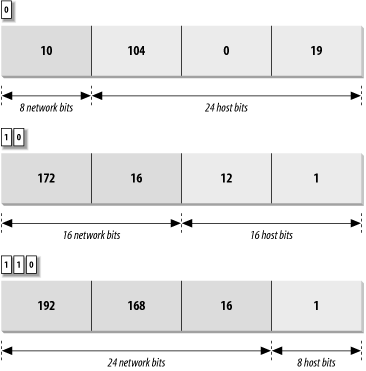
The second address is 172.16.12.1. The two high-order bits are 1 0, meaning that 16 bits define the network and 16 bits define the host. Viewed in a byte-oriented way, the first byte falls between 128 and 191, so the address refers to host 12.1 on network 172.16. Two bytes identify the network and two identify the host.
Finally, in the address 192.168.16.1, the three high-order bits are 1 1 0, indicating that 24 bits represent the network and 8 bits represent the host. The first byte of this address is in the range from 192 to 223, so this is the address of host 1 on network 192.168.16three network bytes and one host byte.
Evaluating addresses according to the class rules discussed above limits the length of network numbers to 8, 16, or 24 bits1, 2, or 3 bytes. The IP address, however, is not really byte-oriented. It is 32 contiguous bits. The address bit mask provides a flexible way to define the network and host portions of an address. IP uses the network portion of the address to route the datagram between networks. The full address, including the host information, is used to identify an individual host. Because of the dual role of IP addresses, the flexibility of address masks not only makes more addresses available for use, but also has a positive impact on routing.
2.2.4 CIDR Blocks and Route Aggregation
The IP address, which provides universal addressing across all of the networks of the Internet, is one of the great strengths of the TCP/IP protocol suite. However, the original class structure of the IP address had weaknesses. The TCP/IP designers did not envision the enormous scale of today's network. When TCP/IP was being designed, networking was limited to large organizations that could afford substantial computer systems. The idea of a powerful Unix system on every desktop did not exist. At that time, a 32-bit address seemed so large that it was divided into classes to reduce the processing load on routers, even though dividing the address into classes sharply reduced the number of host addresses actually available for use. For example, assigning a large network a single class B address instead of six class C addresses reduced the load on the router because the router needed to keep only one route for that entire organization. However, an organization that was assigned the class B address probably did not have 64,000 computers, so most of the host addresses available to the organization were never used.
The class-structured address design was critically strained by the rapid growth of the Internet. At one point it appeared that all class B addresses might be rapidly exhausted. The rapid depletion of the class B addresses showed that three primary address classes were not enough: class A was much too large and class C was much too small. Even a class B address was too large for many networks, but was used because it was better than the alternatives.
The obvious solution to the class B address crisis was to force organizations to use multiple class C addresses. There were millions of these addresses available and they were in no immediate danger of depletion. As is often the case, the obvious solution was not as simple as it seemed. Each class C address requires its own entry within the routing table. Assigning thousands or millions of class C addresses would cause the routing table to grow so rapidly that the routers would soon be overwhelmed. The solution required the new way of looking at addresses that address masks provide; it also required a new way of assigning addresses.
Originally network addresses were assigned in more or less sequential order as they were requested. This worked fine when the network was small and centralized. However, it did not take network topology into account. Thus, only random chance determined if the same intermediate routers would be used to reach network 195.4.12.0 and network 195.4.13.0, which makes it difficult to reduce the size of the routing table. Addresses can be aggregated only if they are contiguous numbers and are reachable through the same route. For example, if addresses are contiguous for one service provider, a single route can be created for that aggregation because that service provider will have a limited number of connections to the Internet. But if one network address is in France and the next contiguous address is in Australia, creating a consolidated route for these addresses is not possible.
Today, large, contiguous blocks of addresses are assigned to large network service providers in a manner that better reflects the topology of the network. The service providers then allocate chunks of these address blocks to the organizations to which they provide network services. Because the assignment of addresses reflects the topology of the network, it permits route aggregation. Under this scheme, we know that network 195.4.12.0 and network 195.4.13.0 are reachable through the same intermediate routers. In fact, both of these addresses are in the range of the addresses assigned to Europe, 194.0.0.0 to 195.255.255.255.
Assigning addresses that reflect the topology of the network enables route aggregation but does not implement it. As long as network 195.4.12.0 and network 195.4.13.0 were interpreted as separate class C addresses, they still required separate entries in the routing table. The development of address masks not only increased the usable address space, but it improved routing.
The use of an address mask instead of the old address classes to determine the destination network is called Classless Inter-Domain Routing (CIDR).[4] CIDR requires modifications to the routers and routing protocols. The protocols need to distribute, along with the destination addresses, address masks that define how the addresses are interpreted. The routers and hosts need to know how to interpret these addresses as "classless" addresses and how to apply the bit mask that accompanies the address. All new operating systems and routing protocols support address masks.
[4] CIDR is pronounced "cider."
CIDR was intended as an interim solution, but it has proved much more durable than its designers imagined. CIDR has provided address and routing relief for many years and is capable of providing it for many more years to come. The long-term solution for address depletion is to replace the current addressing scheme with a new one. In the TCP/IP protocol suite, addressing is defined by the IP protocol. Therefore, to define a new address structure, the Internet Engineering Task Force (IETF) created a new version of IP called IPv6.
2.2.5 IPv6
IPv6 is an improvement on the IP protocol based on 20 years of operational experience. The original motivation for the new protocol was the threat of address depletion. IPv6 has a very large 128-bit address, so address depletion is not an issue. The large address also makes it possible to use a hierarchical address structure to reduce the burden on routers while still maintaining more than enough addresses for future network growth. But large addresses are only one of the benefits of the new protocol. Other benefits of IPv6 are:
Improved security built into the protocol
Simplified, fixed-length, word-aligned headers to speed header processing and reduce overhead
Improved techniques for handling header options
IPv6 has several good features, but it is still not widely used. This is partly because enhancements to IPv4, improvements in hardware performance, and changes in the way that networks are configured have reduced the demand for the new features of IPv6.
A critical shortage of addresses did not materialize for three reasons:
CIDR makes the assignment of addresses more flexible, which in turn makes more addresses available and permits aggregation to reduce the burden on routers.
Private addresses and NAT have greatly reduced the demand for official addresses. Many organizations prefer to use private addresses for all systems on their internal networks because private addresses reduce the administrative burden and improve security.
Permanent, fixed address assignment is less common than dynamic address assignment. The majority of systems use dynamic addresses temporarily assigned by the configuration protocol DHCP.
The creation of the IPsec standards for IPv4 lessened the need for the security enhancements of IPv6. In fact, many of the security tools and features available for IPv4 systems are not being fully utilized, indicating that the demand for tools that secure the link may have been overestimated.
IPv6 eliminates hop-by-hop segmentation, has a more efficient header design, and features enhanced option processing. These things make it more efficient to process IPv6 packets than to handle IPv4 packets. However, for the vast majority of systems, this increased efficiency is not needed because processing IP datagrams is a very minor task. Most systems are at the edge of the network and handle relatively few communications packets. Processor speed and memory have increased enormously while hardware prices have fallen. Most managers would rather buy more hardware using the proven IPv4 protocol than risk implementing the new IPv6 protocol just to save a few machine cycles. Only those systems located near the core of the network would truly benefit from this efficiency, and although important, those systems are relatively few in number.
All of these things have worked together to lessen the demand for IPv6. This lack of demand has limited the number of organizations that have adopted IPv6 as their primary communications protocol, and a large user community is the one thing that a protocol needs to be truly successful. We use communications protocols to communicate with other people. If there are not enough people using the protocol, we don't feel the need to use it. IPv6 is still in the early-adopter phase. Most organizations do not use IPv6 at all, and many that do use it only for experimental purposes.[5] Between organizations, most IPv6 communications are encapsulated inside IPv4 datagrams and sent over the Internet inside IPv4 tunnels. It will be some time before it is the primary protocol of operational networks.
[5] Both Solaris and Linux include support for IPv6 if you wish to experiment with it.
If you run an operational network, you should not be overly concerned with IPv6. The current generation of TCP/IP (IPv4), with the enhancements that CIDR and other extensions provide, should be more than adequate for your current network needs. On your network and the Internet, you will use IPv4 and 32-bit IP addresses.


