Section 1.6. Transport Layer
The protocol layer just above the Internet Layer is the Host-to-Host Transport Layer, usually shortened to Transport Layer. The two most important protocols in the Transport Layer are Transmission Control Protocol (TCP) and User Datagram Protocol (UDP). TCP provides reliable data delivery service with end-to-end error detection and correction. UDP provides low-overhead, connectionless datagram delivery service. Both protocols deliver data between the Application Layer and the Internet Layer. Applications programmers can choose whichever service is more appropriate for their specific applications.
1.6.1 User Datagram Protocol
The User Datagram Protocol gives application programs direct access to a datagram delivery service, like the delivery service that IP provides. This allows applications to exchange messages over the network with a minimum of protocol overhead.
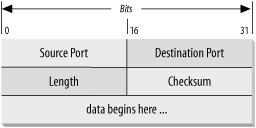
UDP is an unreliable, connectionless datagram protocol. As noted, "unreliable" merely means that there are no techniques in the protocol for verifying that the data reached the other end of the network correctly. Within your computer, UDP will deliver data correctly. UDP uses 16-bit Source Port and Destination Port numbers in word 1 of the message header to deliver data to the correct applications process. Figure 1-8 shows the UDP message format.
Figure 1-8. UDP message format
Why do applications programmers choose UDP as a data transport service? There are a number of good reasons. If the amount of data being transmitted is small, the overhead of creating connections and ensuring reliable delivery may be greater than the work of re-transmitting the entire data set. In this case, UDP is the most efficient choice for a Transport Layer protocol. Applications that fit a query-response model are also excellent candidates for using UDP. The response can be used as a positive acknowledgment to the query. If a response isn't received within a certain time period, the application just sends another query. Still other applications provide their own techniques for reliable data delivery and don't require that service from the Transport Layer protocol. Imposing another layer of acknowledgment on any of these types of applications is inefficient.
1.6.2 Transmission Control Protocol
Applications that require the transport protocol to provide reliable data delivery use TCP because it verifies that data is delivered across the network accurately and in the proper sequence. TCP is a reliable, connection-oriented, byte-stream protocol. Let's look at each of these characteristics in more detail.
TCP provides reliability with a mechanism called Positive Acknowledgment with Re-transmission (PAR). Simply stated, a system using PAR sends the data again unless it hears from the remote system that the data arrived OK. The unit of data exchanged between cooperating TCP modules is called a segment (see Figure 1-9). Each segment contains a checksum that the recipient uses to verify that the data is undamaged. If the data segment is received undamaged, the receiver sends a positive acknowledgment back to the sender. If the data segment is damaged, the receiver discards it. After an appropriate timeout period, the sending TCP module re-transmits any segment for which no positive acknowledgment has been received.
Figure 1-9. TCP segment format
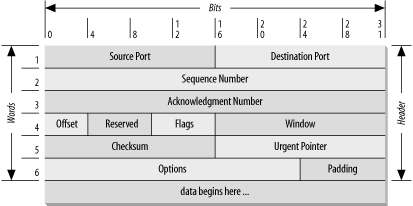
TCP is connection-oriented. It establishes a logical end-to-end connection between the two communicating hosts. Control information, called a handshake, is exchanged between the two endpoints to establish a dialogue before data is transmitted. TCP indicates the control function of a segment by setting the appropriate bit in the Flags field in word 4 of the segment header.
The type of handshake used by TCP is called a three-way handshake because three segments are exchanged. Figure 1-10 shows the simplest form of the three-way handshake. Host A begins the connection by sending host B a segment with the "Synchronize sequence numbers" (SYN) bit set. This segment tells host B that A wishes to set up a connection, and it tells B what sequence number host A will use as a starting number for its segments. (Sequence numbers are used to keep data in the proper order.) Host B responds to A with a segment that has the "Acknowledgment" (ACK) and SYN bits set. B's segment acknowledges the receipt of A's segment, and informs A which sequence number host B will start with. Finally, host A sends a segment that acknowledges receipt of B's segment, and transfers the first actual data.
Figure 1-10. Three-way handshake
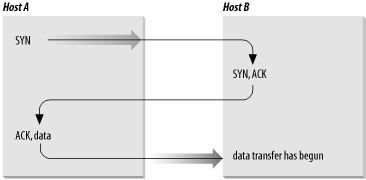
After this exchange, host A's TCP has positive evidence that the remote TCP is alive and ready to receive data. As soon as the connection is established, data can be transferred. When the cooperating modules have concluded the data transfers, they will exchange a three-way handshake with segments containing the "No more data from sender" bit (called the FIN bit) to close the connection. It is the end-to-end exchange of data that provides the logical connection between the two systems.
TCP views the data it sends as a continuous stream of bytes, not as independent packets. Therefore, TCP takes care to maintain the sequence in which bytes are sent and received. The Sequence Number and Acknowledgment Number fields in the TCP segment header keep track of the bytes.
The TCP standard does not require that each system start numbering bytes with any specific number; each system chooses the number it will use as a starting point. To keep track of the data stream correctly, each end of the connection must know the other end's initial number. The two ends of the connection synchronize byte-numbering systems by exchanging SYN segments during the handshake. The Sequence Number field in the SYN segment contains the Initial Sequence Number (ISN), which is the starting point for the byte-numbering system. For security reasons the ISN should be a random number.
Each byte of data is numbered sequentially from the ISN, so the first real byte of data sent has a Sequence Number of ISN+1. The Sequence Number in the header of a data segment identifies the sequential position in the data stream of the first data byte in the segment. For example, if the first byte in the data stream was sequence number 1 (ISN=0) and 4000 bytes of data have already been transferred, then the first byte of data in the current segment is byte 4001, and the Sequence Number would be 4001.
The Acknowledgment Segment (ACK) performs two functions: positive acknowledgment and flow control. The acknowledgment tells the sender how much data has been received and how much more the receiver can accept. The Acknowledgment Number is the sequence number of the next byte the receiver expects to receive. The standard does not require an individual acknowledgment for every packet. The acknowledgment number is a positive acknowledgment of all bytes up to that number. For example, if the first byte sent was numbered 1 and 2000 bytes have been successfully received, the Acknowledgment Number would be 2001.
The Window field contains the window, or the number of bytes the remote end is able to accept. If the receiver is capable of accepting 6000 more bytes, the window would be 6000. The window indicates to the sender that it can continue sending segments as long as the total number of bytes that it sends is smaller than the window of bytes that the receiver can accept. The receiver controls the flow of bytes from the sender by changing the size of the window. A zero window tells the sender to cease transmission until it receives a non-zero window value.
Figure 1-11 shows a TCP data stream that starts with an Initial Sequence Number of 0. The receiving system has received and acknowledged 2000 bytes, so the current Acknowledgment Number is 2001. The receiver also has enough buffer space for another 6000 bytes, so it has advertised a window of 6000. The sender is currently sending a segment of 1000 bytes starting with Sequence Number 4001. The sender has received no acknowledgment for the bytes from 2001 on, but continues sending data as long as it is within the window. If the sender fills the window and receives no acknowledgment of the data previously sent, it will, after an appropriate timeout, send the data again starting from the first unacknowledged byte.
Figure 1-11. TCP data stream
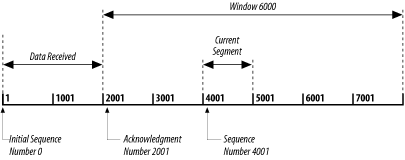
In Figure 1-11 re-transmission would start from byte 2001 if no further acknowledgments are received. This procedure ensures that data is reliably received at the far end of the network.
TCP is also responsible for delivering data received from IP to the correct application. The application that the data is bound for is identified by a 16-bit number called the port number. The Source Port and Destination Port are contained in the first word of the segment header. Correctly passing data to and from the Application Layer is an important part of what the Transport Layer services do.


