Section 1.3. TCP/IP Protocol Architecture
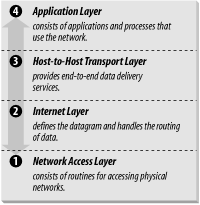
While there is no universal agreement about how to describe TCP/IP with a layered model, TCP/IP is generally viewed as being composed of fewer layers than the seven used in the OSI model. Most descriptions of TCP/IP define three to five functional levels in the protocol architecture. The four-level model illustrated in Figure 1-2 is based on the three layers (Application, Host-to-Host, and Network Access) shown in the DOD Protocol Model in the DDN Protocol Handbook Volume 1, with the addition of a separate Internet layer. This model provides a reasonable pictorial representation of the layers in the TCP/IP protocol hierarchy.
Figure 1-2. The TCP/IP architecture
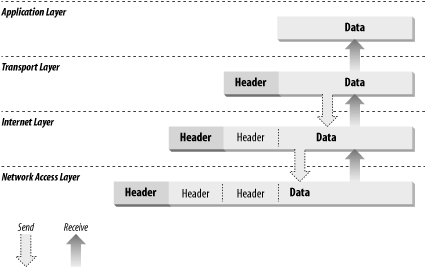
As in the OSI model, data is passed down the stack when it is being sent to the network, and up the stack when it is being received from the network. The four-layered structure of TCP/IP is seen in the way data is handled as it passes down the protocol stack from the Application Layer to the underlying physical network. Each layer in the stack adds control information to ensure proper delivery. This control information is called a header because it is placed in front of the data to be transmitted. Each layer treats all the information it receives from the layer above as data, and places its own header in front of that information. The addition of delivery information at every layer is called encapsulation. (See Figure 1-3 for an illustration of this.) When data is received, the opposite happens. Each layer strips off its header before passing the data on to the layer above. As information flows back up the stack, information received from a lower layer is interpreted as both a header and data.
Figure 1-3. Data encapsulation
Each layer has its own independent data structures. Conceptually, a layer is unaware of the data structures used by the layers above and below it. In reality, the data structures of a layer are designed to be compatible with the structures used by the surrounding layers for the sake of more efficient data transmission. Still, each layer has its own data structure and its own terminology to describe that structure.
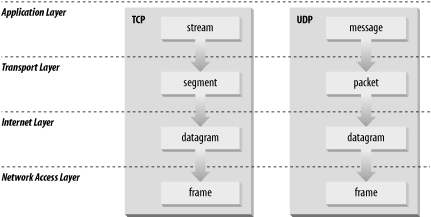
Figure 1-4 shows the terms used by different layers of TCP/IP to refer to the data being transmitted. Applications using TCP refer to data as a stream, while applications using UDP refer to data as a message. TCP calls data a segment, and UDP calls its data a packet. The Internet layer views all data as blocks called datagrams. TCP/IP uses many different types of underlying networks, each of which may have a different terminology for the data it transmits. Most networks refer to transmitted data as packets or frames. Figure 1-4 shows a network that transmits pieces of data it calls frames.
Figure 1-4. Data structures
Let's look more closely at the function of each layer, working our way up from the Network Access Layer to the Application Layer.


