SQL Server and the .NET Framework
The Microsoft .NET Framework is one of the most significant technology shifts Microsoft has ever made. It is truly Microsoft's answer to J2EE/J2SE. The .NET Framework is a multitiered platform architecture that consists of developer tools, Web Services, a set of strongly typed programming languages that are syntactically identical whether used to program for the Web or for the desktop, a common language runtime, a set of framework classes encapsulating areas of common functionality, and a greatly improved data access model.
Microsoft SQL Server 2000 sits firmly in the heart of the .NET Framework as the major data provider for this framework. One hundred percent of the power of SQL Server can be taken advantage of within any .NET application that is developed and also with any external system as well. (Data can be transferred to and from other platforms via XML.)
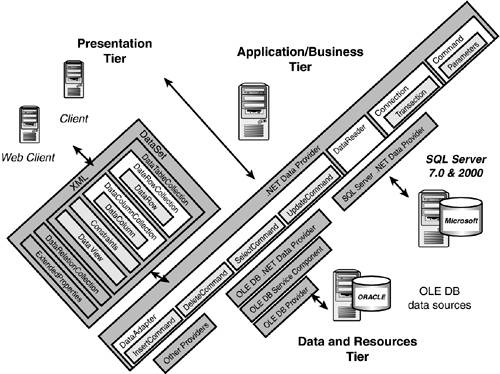
Microsoft's .NET Framework ships with a set of useful built-in classes. These classes contain many of the objects you'll use to create applications, both for the Web and for the desktop, such as all built-in Web controls, Windows forms controls, and collection objects. Several of these built-in classes comprise ADO.NET (the data layer for .NET). It will be this layer that will be focused on in this book because it directly relates to how SQL Server 2000 fits into the .NET Framework.
Figure 3.1 illustrates the basic framework components that comprise the .NET Framework and the ADO.NET components.
Figure 3.1. The Microsoft .NET Framework.
SQL Server and the .NET Framework are discussed in much more detail in Chapter 46, "SQL Server and the Microsoft .NET Framework."


